We
begin the new year of 2018 on a very sad note…

One
of the most prolific comic book writers of all time, and a major influence on
my own comics work, Vic Lockman, passed away (sadly unnoticed) in June of 2017,
at the age of 90!
To
better appreciate the accomplishments of Vic Lockman, please first read the
Blog posts of Mark Evanier, who worked as a writer for Western Publishing’s Gold
Key Comics during the 1970’s, and was a then-contemporary of Mr. Lockman… HERE
and more HERE!

Below
is a piece I wrote on Vic Lockman for this Blog’s “ancestor”, THE ISSUE AT HAND
fanzine and APA column, back in early 2001 - with all illustrations added especially for this post! After that, I’ll be back with a few examples of how the unique stylings
of Vic Lockman influenced – and CONTINUES to influence – my own comic book work…
and another “special treat!”
But,
first… please join me in 2001 – already in progress…
With
the release of Archie Comics’ Veronica # 106 (December, 2000),
veteran comics writer Vic Lockman
finds himself with work published in six
different decades!


Another "Veronica" story by Vic Lockman, from issue # 96, released at the end of 1999!
Yes,
comic book readers of the 1950s, ‘60s, ‘70’s, ‘80s, ‘90s, and now the “Oh-Ohs”
have experienced the talents of one of comics’ most prolific writers of all
time.
While
he has contributed some “art” (in quotes because, frankly, it wasn’t all that
great) it was Vic Lockman’s strengths as a WRITER that would carry him from the
middle of one century into the beginning of the next! Perhaps wisely, his art would be mostly relegated
to “game and puzzle pages” throughout his prime period of the ‘60s and ‘70s,
followed (oddly) by a few isolated efforts for Gladstone Series II’s Disney comics during the later 1990s.

As
the ‘50s gave way to the ‘60s, and for the balance of Western Publishing’s years
as a comics publisher ending in 1984, Vic Lockman would handle the vast
majority of “funny” or “animated” character titles to emerge from Western’s Dell,
Gold Key, and Whitman comic book lines, with an emphasis on Disney, Warner
Bros., Hanna-Barbera, and Walter Lantz characters.


Creatively,
Lockman would reach his height during the early-to-mid 1960’s, with such stories of note
as:
“Time
Jumper” Huckleberry Hound #
5 (May-June, 1960). Armed with a mere children’s book, Huck
displays ingenuity and heroism throughout history. With art by the great Hanna-Barbera comics
artist Harvey Eisenberg, this tale of historical juxtaposition is a
mini-masterpiece for both writer and artist!


“The
Flintstones meet Frankenstein and Dracula” (…nowhere NEAR as bad as it sounds!) The Flintstones # 33 (April, 1966). Time travel with a twist… the monsters
journey back to Bedrock and are mistaken for Fred’s visiting cousins!


“The
Battle at Hadrian’s Wall” Donald
Duck # 107 (May, 1966). Donald struts his stuff as a Roman centurion.


“Og’s
Iron Bed” Donald Duck # 109
(September, 1966). Released July,
26, 1966. An historical adventure with
(so I’m told by folks who know more about this than I) some Biblical
overtones! Establishes Lockman’s
creation Emil Eagle as a full-fledged villain.


“Trapped
in Time” Walt Disney’s Comics and Stories #
323 – 326. (Aug. – Nov., 1967) The second
best of all the Mickey Mouse serials originally produced for comic
books. Mickey and Goofy set out to
rescue “time lost” inventor Gyro Gearloose.


2018 UPDATE: More recent information would indicate that "Trapped in Time" was actually written by Cecil Beard, and not Vic Lockman. Though I remain certain of the other stories listed here.
“The Dragon’s Amulet” Uncle Scrooge # 74 (April, 1968). The first full-length American Uncle Scrooge adventure not produced by Carl Barks. Intrigue surrounds a mysterious Asian figurine in Scrooge’s possession.
“The Dragon’s Amulet” Uncle Scrooge # 74 (April, 1968). The first full-length American Uncle Scrooge adventure not produced by Carl Barks. Intrigue surrounds a mysterious Asian figurine in Scrooge’s possession.


In
addition, Vic Lockman will always have my eternal gratitude for his handling of
the comic book version of the story in which Fred Flintstone meets The Great Gazoo. (The Flintstones # 34
June, ‘66) Demonstrating wisdom far in
excess of that of the producers of the TV series, Lockman sent Gazoo back into
space permanently at story’s end!


Perhaps
THE FLINTSTONES TV Series would have run still longer, if Vic Lockman had some
say in its direction!
 |
| Go home, Gazoo! |
Stylistically,
Lockman’s stories (…though always uncredited during his tenure at Western) are
among the easiest to identify, once you learn to recognize the keys.
Dialogue: Vic Lockman’s may be among the most unique
dialogue in comics. Here are a few
things to look for.
Rhyming: While executing a plot to rob Uncle Scrooge,
a Beagle Boy would utter the following:
“Yo-Ho-Ho!
We’ll soon be in the dough!”

Alliteration: A villain might be described as: “A doer of dastardly deeds”, while
a hero could be referred to as “A
super somebody or other”. Cheers
may be directed from one character to another as: “Yay for you!”

Regardless
of how red-blooded and “male” a character might be, a reaction of distressed
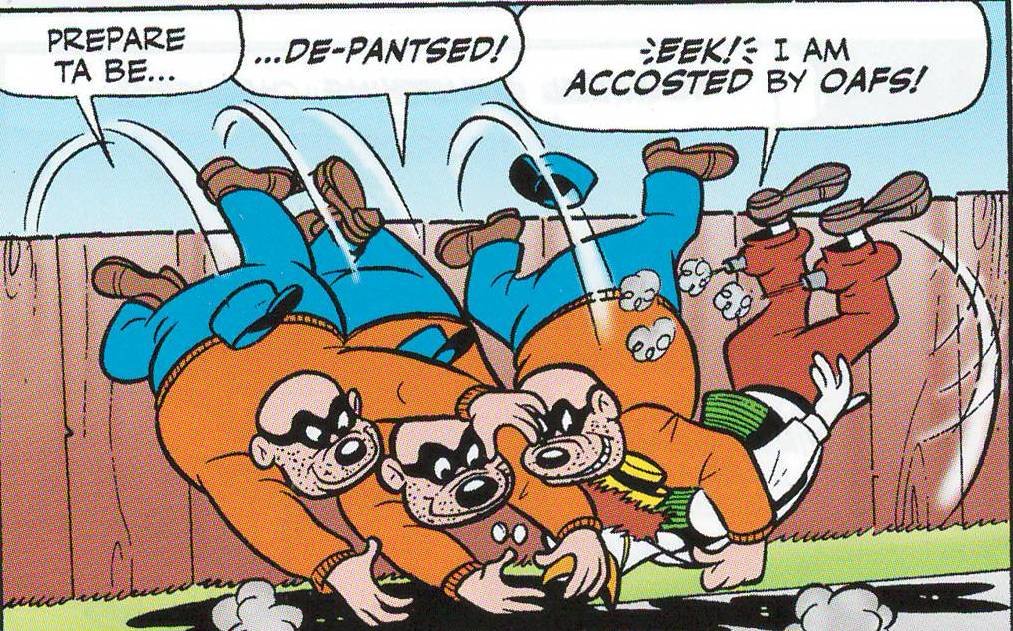
surprise will often begin with “Eek!”,
and no matter how far from Canada a story might be set, expressions of
questioning and puzzlement always begin with “Eh?”.

Story and Plot Conventions: Things to look for include:
A
device or object, often intended or designed for a specific purpose within the
story, being used at the story’s end for a different, more incongruous or more
offbeat purpose. If Gyro Gearloose
invents something for someone in a Vic Lockman story, you can COUNT on an
ending like this! In fact, it’s a
virtual (…Ahem!) “lock, man”!

Like this HAMMOCK, for instance!
The
starring character triumphs over adversity… AND (…predating the advent of the
Discover Card) gets a cash reward.
This is especially true of the stories Lockman has written for Goofy over the years. In fact, a running joke I had with my late
friend Chris Barat is the line: “But,
Goofy, what will you do with the reward money?”

Given
this, Lockman’s stories were far less cynical in nature than those of his
contemporary, Carl Barks. The starring
characters almost always emerged “Vic-torious” (Sorry!) and endings were
generally “happy” or, at worst, restored the status quo.

Taking
a page (…Literally!) from the DC Comics of the 1950s and 60s, Lockman’s longer
adventure stories often began with a splash panel depicting the action to come
already in full swing.
 |
| From DETECTIVE COMICS # 326 (APRIL 1964) |
For instance, “The
Battle at Hadrian’s Wall” opens with a full page of Centurion Donald Duck
being assaulted by the boulders of attacking barbarians.
 |
| From DONALD DUCK # 107 (MAY, 1966) |
Lockman’s captioning would usually say
something to the effect of: “How did
Donald find himself in such a predicament? Let’s
turn back the clock and find out…”. Often, this bit would be accompanied by an
anthropomorphic “alarm clock” walking backward.
By
contrast, Carl Barks almost always began an adventure opus conventionally in a
domestic setting, and moved the story forward from that familiar point of
origin.

Lockman
would remain with Western Publishing until their cessation as a comic book
publisher in 1984. Over those years, he would produce a
tremendous volume of work, and, in total honesty, a good deal of what followed
the period of the mid-late 1960s was average to poor.

During the Whitman years of the early to mid
1980s, much of it was downright dreadful.
I don’t hold Lockman fully responsible for this, as shorter dictated
story lengths and increasing restrictions would have a decided effect on nearly
ALL writing to emerge from Western as the tired publisher plodded on toward its
demise.


That's one mighty fearsome finger on that Beagle Boy! Hope it's not loaded! From UNCLE SCROOGE # 194 (1981).
As
the eighties wore on, Lockman found employment as part of the “Disney Studio
Program”, which provided comic book stories for foreign licensees. Some of these stories found their way into Gladstone
Series I’s Ducktales and other comic
titles published domestically.
The
nineties saw Vic Lockman producing original story and ( Eek! ) art on a
sporadic basis for the Gladstone Series
II Disney comic titles. He even
self-published a series of comic art instruction books during the period, which
were advertised in those same Gladstone comics. ( Double Eek! )

He also saw duty on the new Flintstones
title published by Archie Comics during the middle of the decade, joining artist Pete
Alvarado with whom he collaborated on The Flintstones during the Silver
Age for Gold Key.


From Archie Comics' THE FLINTSTONES # 15 (Nov. 1996).
After
the Hanna-Barbera license was “brought home” to DC Comics, Lockman’s
association with Archie apparently led to an occasional assignment on the Veronica
title, which brings us to the year 2000
and a sixth decade of his actively working in comics!

Another Vic Lockman story from VERONICA # 96!
Good
night, Mr. Lockman, and good comics reading… and Yay for you, Vic!
[ END of 2001 Material ]
Disclaimer: As noted, the above was written in early 2001 when much less about "who-did-what" was actually known - and more was left pure speculation and association with other identified works. In my desire to present this material "as-written" in 2001, I note that perhaps certain stories could possibly be now-attributed to others. But, back then, it sure seemed like Vic Lockman wrote these particular tales, based on the identifying criteria I've outlined. End Disclaimer.
For more of Vic Lockman’s better comics work, go to THIS POST on the Gold Key Comics run of THE JETSONS, which (after the overall
comic-book history lesson) discusses three good Lockman Jetsons stories.


For "Bird Bothered Hero", you SHOULD throw stuff! BOOO!

I'm GLAD this scan came out crooked! GLAD! GLAD! GLAD!
Though we CAN blame the WRITING on him, we cannot do so for
the WORST ART I’ve ever beheld in such a comic – and the unattractive and
uncomfortably large LETTERING that come together with said writing to make this
story so uniquely bad! See the panel
below – and read THIS POST from GeoX for which I give a full-length lecture in the
comments section!

But, for better or for worse (mostly better), Vic Lockman remains a huge
influence on the comics work I do today – particularly when it comes to his
trademark alliteration and unusual and quirky turns of phrase. Here are some examples:


I named this character after him, in IDW’s UNCLE SCROOGE # 11!


And, as our regular readers know, it was my great honor to “collaborate”
with Vic Lockman, separated by about five decades on this story for IDW’s UNCLE
SCROOGE # 29! More on that HERE!


EXTRA BONUS “VICtory Lap”:
We all know that Vic Lockman’s writing got (shall we say) a little “loopy”
as we approached the end of the 1960s.
Perhaps that’s even WHY I enjoyed it so much! Who can say…


I don’t think ANYONE ELSE BUT Vic Lockman could have come up with THIS!


...Or THIS, and I could go on forever!
Thank you, Mr. Lockman – for a lifetime of wonderfully unique stories, and for your continued influence on me, as I carry on your legacy! Yay for you! ...And thanks a jillion!


